
Why Fraud Patterns Repeat Across Carriers
Fraud schemes rarely appear entirely new. After reviewing enough claims, investigators begin to notice that many fraudulent claims share familiar structures beneath small variations. This article explores why fraud patterns repeat across carriers and how experienced investigators recognize when separate claims may follow the same underlying playbook
Claim Analysis Group, LLC
9/14/20264 min read

Fraud rarely presents itself as something entirely new.
After reviewing enough claims over time, investigators begin to notice a recurring reality: many fraudulent claims differ only at the surface. Names change. Dates shift. Loss descriptions are adjusted just enough to appear unique. But beneath those variations, the structure often remains the same.
At first glance, each claim may appear unrelated. Different insureds, different travel dates, and slightly different narratives can make the files seem independent. Individually, they often appear plausible. Over time, however, something familiar begins to emerge. The framework of the claim starts to look the same.
When the Documents Look Familiar
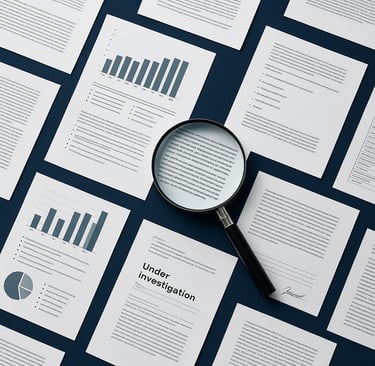
One of the earliest indicators that a pattern may be forming is document familiarity. A document submitted in a new claim resembles something seen before. The layout feels recognizable. The wording follows a similar structure. Certain details appear in the same places investigators have encountered previously. Initially, this resemblance can feel coincidental. Many legitimate documents share standard formats.
But as more claims are reviewed, the similarities become harder to ignore.
The insured name changes.
The dates are adjusted.
The location of the loss shifts slightly.
Yet the supporting documentation remains strikingly consistent. In some cases, documents appear nearly identical, with only minor edits to names or dates. Within a single claim file, the materials may appear legitimate. Across multiple claims reviewed over time, those similarities begin to stand out. This repetition reveals an important truth about how many fraud schemes operate.
Fraud Schemes Often Follow a Playbook
Fraud is often imagined as highly sophisticated and constantly evolving. In practice, many schemes rely less on innovation and more on repetition.
Once a particular approach results in a paid claim, it is often reused.
Fraudsters tend to retain the same narrative structure, document templates, and supporting explanations that have worked previously. Small adjustments are made to avoid obvious duplication, but the underlying framework frequently remains intact.
To an individual claims handler, the documentation may appear plausible. But when investigators review claims across time and across carriers, what once seemed isolated can begin to resemble a repeating playbook.
Why the Same Approach Gets Reused
There are practical reasons fraud patterns repeat. First, fraudsters tend to reuse methods that have already succeeded. If a particular narrative or document structure resulted in payment once, there is little incentive to change it significantly.
Second, many schemes assume that insurers operate in isolation. Fraudsters often believe each carrier evaluates claims independently, making it unlikely that similarities across carriers will be recognized.
Third, minor variations are often enough to pass an initial review. Changing the insured’s name, adjusting dates, or modifying certain details can make a document appear unique even when the underlying template remains unchanged.
These assumptions allow the same scheme to surface repeatedly in slightly different forms.
Fraud as a Probability Exercise
Fraud patterns also repeat because many schemes rely on probability rather than precision.
Fraudsters understand that claims are handled by different people under different conditions. Some claims are reviewed by experienced investigators. Others are handled by adjusters managing heavy workloads and tight timelines.
That variability is part of the strategy.
A claim submitted today may be reviewed by someone new to the role. Another may be handled during a period of high volume, where documentation that appears credible at first glance receives limited scrutiny.
Under those conditions, fraudsters may submit multiple claims with similar narratives or documentation, relying on the likelihood that at least one will progress.
From their perspective, the approach is simple: submit enough claims and rely on probability to produce a successful outcome. For investigators, this context matters. What appears to be an isolated claim may actually represent one attempt within a broader pattern.
The Limits of Technology in Certain Claim Environments
Analytical tools, automated detection systems, and data‑driven models have become increasingly valuable in identifying fraud patterns across large datasets. In many lines of business, these tools are essential. However, not every claim environment lends itself easily to automated detection.
In some areas, particularly travel insurance, individual claims often involve relatively modest amounts. While losses can accumulate across time, the value of each individual claim may not justify complex analytical deployment.
Yet fraud still occurs.
In these environments, patterns are often recognized first through experience rather than automation. Familiar documentation, recurring narratives, and repeated claim structures are identified because investigators have reviewed enough files to recognize when something looks familiar.
Technology can support detection. It does not replace experienced investigative judgment.
When Experience Reveals Familiar Structures
As investigators review claims over time, certain structures begin to feel recognizable.
A narrative follows the same progression seen in earlier files. Supporting documentation is presented in a similar order. Explanations appear in ways that feel familiar, even when the insureds and loss details differ. These similarities do not automatically establish that claims are connected.
However, experience allows investigators to recognize when a claim follows a structure that has appeared before. Over time, this awareness becomes one of the most valuable tools in identifying potential fraud patterns.
Often, that recognition prompts a closer look.
When Familiar Patterns Appear
Recognizing a familiar claim structure does not mean a claim is fraudulent. Similar documentation and narratives can occur legitimately, particularly in industries where standardized forms and service providers are common.
However, experienced investigators understand that familiarity is worth noting. When a claim resembles patterns seen in earlier files, investigators often begin by reviewing the claim more deliberately. They may compare the documentation against other claims they have encountered, paying attention to formatting, phrasing, and document structure.
They may also examine whether the circumstances surrounding the claim follow a pattern that has appeared previously. Sometimes these similarities prove to be coincidence. Other times they reveal that what initially appeared to be separate claims share a common framework.
Recognizing that possibility does not resolve the investigation but it often changes how the file is approached.
Instead of viewing the claim in isolation, investigators begin to consider whether the claim may be part of a broader pattern that only becomes visible through experience.
Closing Reflection
Fraud schemes rarely succeed because they are innovative. More often, they succeed because the same approach is reused in environments where claims are reviewed individually.
But patterns do not remain invisible forever.
A familiar document. A repeated narrative. A structure that closely mirrors something seen before.
What appears ordinary within a single claim file can become unmistakable when viewed through experience. And often, that recognition is the first step toward understanding that what initially appeared to be isolated claims may, in fact, follow a much larger pattern.
Tel: 713-487-7297
Email: contact@claimanalysisgroup.com
Address: 11811 North Freeway, Suite 222, Houston, TX 77060
© 2026 Claim Analysis Group, LLC. All Rights Reserved.
Quick Links

